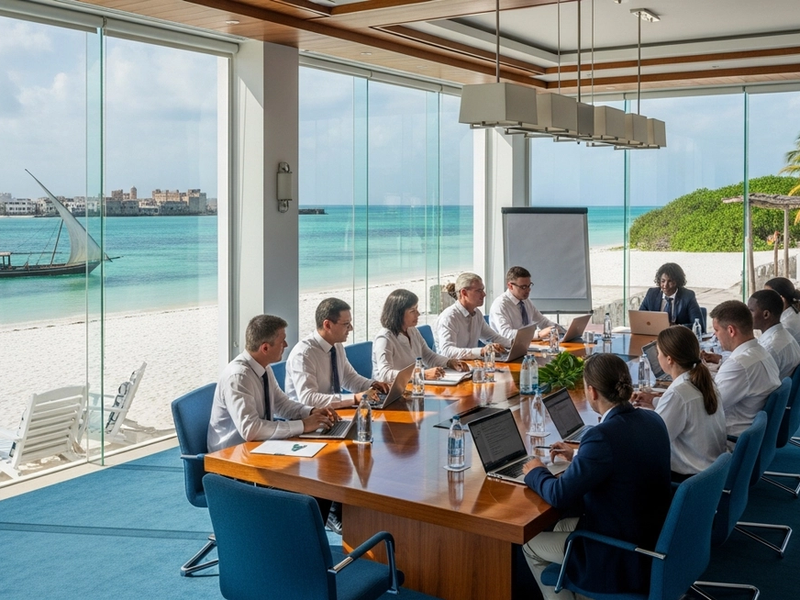
Why MICE is Kenya’s Most Strategic Tourism Bet — and Why Companies Should Invest in 2026
By Emily Wekulo
For years, Kenya’s tourism story was told through wildlife, beaches, and adventure. But quietly, a more resilient and higher-yield sector has been shaping the country’s economic future: Meetings, Incentives Travels, Conferences, and Exhibitions (MICE). Today, MICE is no longer a supporting pillar — it has become the backbone of Kenya’s tourism transformation.
The Numbers Tell a Clear Story
MICE accounts for roughly 27% of international tourist arrivals in Kenya, translating to more than 640,000 business travellers. Kenya’s MICE trajectory between 2025 and early 2026 reflects deliberate national positioning. In 2025, business events contributed a steadily growing share of arrivals, with Nairobi maintaining its lead while coastal and safari circuits absorbed post-event leisure traffic. The national narrative crystallised during the 2025 Jamhuri Day celebrations, where tourism was woven into the broader economic transformation agenda. MICE was acknowledged as a strategic pillar — not merely a travel segment, but a catalyst for investment, knowledge exchange, and regional influence.
Government projections heading into 2026 indicate continued growth in high-value delegates, longer stays driven by bleisure travel, and a deliberate push to disperse conferences beyond traditional urban centres.
Conference participation continues to rise, with tens of thousands of international delegates and hundreds of thousands of local and regional attendees annually.
More importantly, business travellers spend significantly more than leisure tourists and travel throughout the year, helping stabilise tourism revenues beyond seasonal cycles.
Government Strategy: MICE as a National Economic Lever
Kenya is not leaving MICE growth to market forces alone. The government has repositioned business tourism as a strategic economic driver.
The state is actively repositioning Kenya as a global business events hub through:
- Revitalisation of the Kenya National Convention Bureau to enhance global competitiveness
- A national target of five million international arrivals and Sh800 billion in tourism earnings by 2027, with MICE as a core growth engine
- Expansion of convention infrastructure and airport modernisation projects
- Policy reforms aimed at easing visas, strengthening public-private partnerships, and attracting global conferences
This marks a deliberate shift from tourism promotion to tourism industrialisation.
Why MICE Matters Beyond Tourism
Major global summits hosted in Kenya have demonstrated that conferences are platforms for:
- Cross-border investment deals
- Technology transfer and knowledge exchange
- Regional diplomacy and influence
- SME inclusion in global value chains.
This progress is not accidental; it is the result of coordinated national effort. The Kenya Tourism Board has intensified Kenya’s presence across global trade platforms, positioning the country as a competitive and compelling MICE destination. Through refreshed Magical Kenya campaigns, the narrative has shifted from destination marketing to experience marketing — highlighting Kenya as a place where productivity and inspiration coexist. These campaigns are increasingly tailored to business travellers, showcasing Kenya’s ability to deliver both efficiency and emotional resonance.
Policy and infrastructure support from the Ministry of Tourism and Wildlife continues to strengthen the sector’s foundation. Strategic investment in convention infrastructure, public-private partnerships, and investor-friendly frameworks are reinforcing Kenya’s competitiveness in the global meetings market. Meanwhile, sustainability has become a defining differentiator. Through conservation-driven experiences supported by the Kenya Wildlife Service, Kenya offers something few destinations can: the ability to merge corporate engagement with authentic environmental stewardship. Delegates can close deals in the morning and contribute to conservation narratives in the afternoon — a powerful proposition in an era where ESG matters.
For companies, investing in MICE tourism in Kenya is increasingly strategic. Business events hosted in Kenya benefit from strong regional attendance, pan-African accessibility, and experiential depth that enhances delegate satisfaction. Incentive travel programmes enjoy unmatched diversity — from savannah safaris and mountain retreats to coastal escapes — while conferences gain a unique storytelling dimension that elevates brand perception. In a world where experiences shape memory and loyalty, Kenya delivers enduring impressions.
Kenya's Competitive Edge in Africa
While destinations like Kigali and Cape Town dominate traditional rankings, Kenya holds structural advantages.
- Connectivity — Nairobi remains one of Africa's most connected aviation hubs, making it ideal for continental and global events.
- Hybrid experiences — Few destinations combine world-class conference facilities with safari, coastline, and culture within short travel distances.
- Regional gravity — East Africa's rapid growth is pulling corporates, NGOs, and intergovernmental organisations toward Nairobi as a neutral convening hub.
- Cost-to-impact value — Compared to Europe or Asia, Kenya delivers a high experiential return per dollar spent.
Where CTK Fits Into the New MICE Reality
Come Travel Kenya (CTK), an expert DMC and Tour Operator, sits at the intersection of experience design and destination intelligence — precisely where the modern MICE industry is headed.
CTK operates at the intersection of strategy and execution. The company translates Kenya's national tourism ambition into curated, end-to-end MICE experiences — aligning global corporate expectations with local authenticity. From concept design and logistics to experiential programming and post-event leisure extensions, CTK ensures that every event is not just organised, but orchestrated.
What sets Come Travel Kenya apart is its ability to blend precision with creativity. Understanding that modern MICE travellers seek more than functionality, CTK crafts journeys that balance efficiency with emotional depth. Whether designing high-level executive retreats, incentive safaris, or multi-country conference circuits, the focus remains consistent: impact, immersion, and seamless delivery.
As Kenya moves deeper into 2026, the MICE sector stands at an inflection point. Global demand for meaningful business travel is rising, and destinations that can deliver value beyond venues will lead the future. Kenya is already ahead of this curve — driven by strong public-sector support, global branding momentum, and a natural experiential advantage that cannot be replicated.
Come Travel Kenya remains firmly at the centre of this evolution — not just participating in the MICE movement, but shaping it. For organisations seeking a destination that inspires ideas, strengthens partnerships, and leaves a lasting imprint, Kenya is no longer an option. It is the answer.
Why Companies Should Invest in MICE Tourism Now
The case for corporate investment in MICE is no longer experiential — it is strategic.
- Stronger ROI than traditional marketing — Face-to-face engagement continues to outperform digital channels in building trust, partnerships, and deal velocity.
- Talent retention and culture building — Incentive travel remains one of the most powerful tools for employee motivation, leadership alignment, and organisational culture.
- Market expansion into Africa — Africa is one of the fastest-growing consumer and innovation frontiers. MICE provide structured entry points into these ecosystems.
- Brand positioning through experiences — Where a company hosts its events communicates as much as what it sells. Hosting in Kenya signals growth, frontier thinking, and global relevance.
- Year-round strategic engagement — Unlike leisure tourism, MICE enables repeat engagement cycles, such as annual summits, partner forums, and innovation retreats.
The Future of MICE in Kenya
If current growth trends continue, Kenya is positioning itself as East Africa's undisputed MICE capital.
The next phase will not be defined by whether Kenya attracts events, but by how deeply those events are curated and experienced. In a world where destinations compete on scale, Kenya wins on soul — and the future of MICE will belong to those who understand that.
Article Tags

Emily Wekulo.
Content Writer & StorytellerPart of the Come Travel Kenya team, passionate about sharing Kenya's beauty and culture with the world.
Found this helpful?
Share it with others